
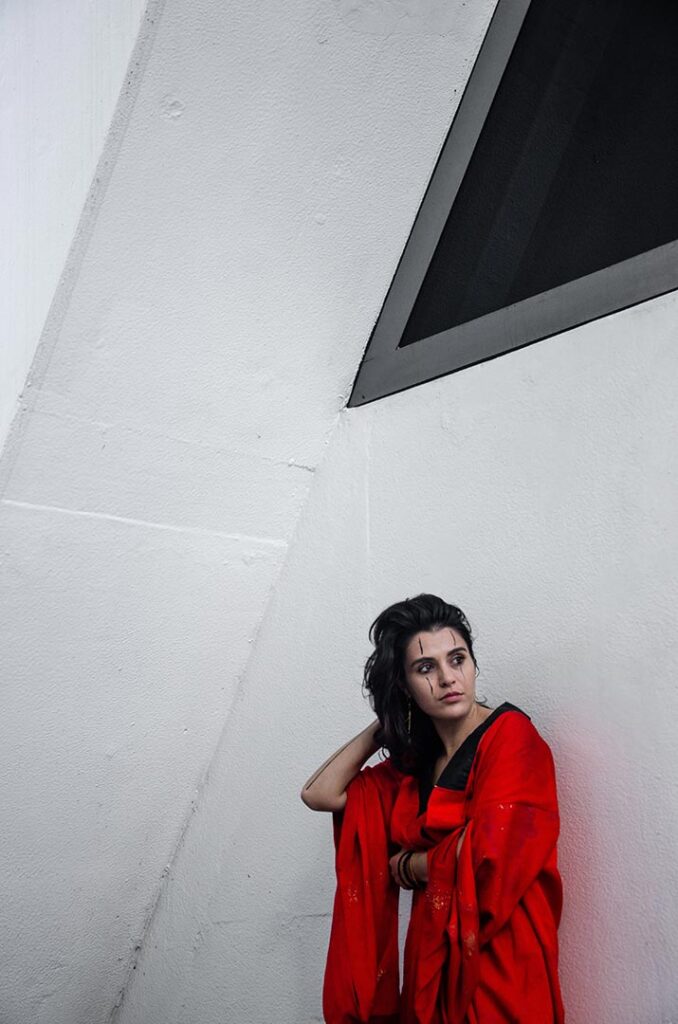
The Fulgurance of a Path Between Worlds
Distinctive. Sonia Al Abdalla is so by virtue of her journey, her vision, and this deeply personal way of inhabiting the world and transforming it into a work of art.
Born in Jordan in 1986 to a Jordanian father and a Romanian mother, Sonia Al Abdalla carries within her the richness of the lands, languages, and cultures that have shaped her existence. Her childhood unfolds between Jordan, Romania, and France, before she continues her path to Rio de Janeiro, where she lives for twelve years. This singular journey is not merely the thread of her biography: it constitutes the raw material of her work and profoundly shapes her quest for identity, her keen sense of freedom, her inner metamorphoses, and her spiritual archaeology.
A self-taught artist, she has built herself with patience, curiosity, and determination. Sonia walks as a pathfinder, seeking inspiration through her readings, her wanderings, and her discoveries. She forages, studies the living world, her creative intelligence finding there, its inspiration and its sacred music. She is an alchemist who observes, questions, and seeks the hidden correspondences between beings, numbers, forms, and symbols. For her, reflection is never separated from sensitivity: it becomes a way of listening to the world, understanding its tensions, and revealing its harmony.
Her practice is resolutely eclectic. Painting, drawing, ceramics, sculpture, photography, and writing respond to one another within the same inner language. At times, words open the path to painting; at others, they emerge from the silence left by the image. Between the two flow music, reading, movement, and dance. As she herself says: "Painting is a meditation for me. I step out of my being to reveal it to the unknown". A process in which creation becomes the language of what words alone cannot express.
Her work is distinguished by remarkable graphic finesse and an economy of means. On paper, her lines seem to whisper. They advance with precision, sculpt emptiness, and bring forth a body, a movement, an emotion, or a memory. Her deliberately restrained palette—black, white, red, blue, and gold: black, abyssal; red, the heartbeat of life; blue, azure infinity and the memory of water; gold, divine light. A few strokes are enough to bring a presence into being.
Deeply inspired by Japanese aesthetics and philosophy, Sonia explores the most elemental forms through drawing and painting.
Yet, at the heart of her artistic approach lies an existential anxiety: “Who am I?”
Through the Japanese prism, she explores the multiple dimensions of being—Eastern and Western, traditional and modern, feminine and masculine, body and spirit, Yin and Yang. These forces are not contradictions, but complementary polarities meant to coexist. Her work seeks to reconcile what appears separate, allowing duality to enter into dialogue until unity is regained. This quest demands lucidity, but also a passionate will: to accept oneself, while transforming oneself, and to continue one's path without renouncing one's freedom.
Her exhibitions take place as readily in galleries as in forests, churches, and heritage sites. The work never imposes itself upon these places; it enters into resonance with their architecture, nature, and silence. The forest becomes a space of breath, the church a place of introspection, paper an intimate territory where memory can finally take shape. Through her travels, her work has gradually opened itself to the world. Presented across Europe, Latin America, and Asia, it continues a sensitive dialogue between cultures, traditions, and perspectives, making each exhibition a space of encounter and resonance.
Sonia Al Abdalla moves forward with a determination that is never merely aesthetic. Her art is, above all, an ascetic practice, a spiritual discipline, a way of inhabiting the world—a prayer. Her artistic presence bears witness to a rare sensitivity, at once fragile, tender, and rugged, and to an underlying yet constant resolve: to transform the fragments of a life into a language, and to make every duality the promise of a renewed unity.